What Is Crown Hair Loss and Can It Be Treated?
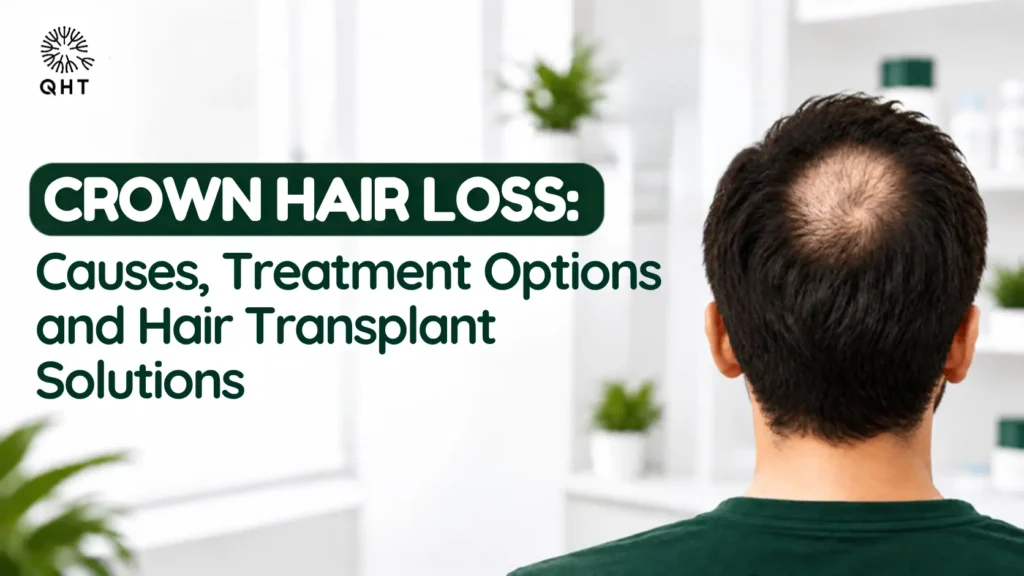
Is crown hair loss treatable? Can I do anything about it? The good news is, crown hair loss can be treated with medications, PRP therapy or a hair transplant, based on the extent of baldness and what works best for your hair type and health.
Why Does Crown Hair Loss Happen?
The crown is also one of the first areas that start thinning (applicable for both men and women). But why does it start there? Here’s a few of the common causes of crown thinning:
i)Genetics – it runs in your genes. If it runs in your family, the crown is likely the first place to show these changes.
ii)DHT – a hormone called dihydrotestosterone tightens the hair follicle making it smaller, and the crown is a place where the follicles are more susceptible to it.
iii)Nutritional deficiencies – deficiencies of iron, Vitamin D, Biotin and Zinc can lead to the processes that cause crown thinning.
iv)Chronic stress – leads to a sudden hair shedding from the crown and top of the scalp, since your hair follicles are prematurely pushed into the telogen phase.
v)Hormonal imbalances – thyroid issues or polycystic ovary syndrome (PCOS) are the other main reasons for crown thinning.
vi)Poor scalp circulation – less blood flow to the crown area leads to weaker follicles and reduced delivery of nutrients.
How Quickly Does Crown Hair Loss Progress?
Crown hair loss is not usually a sudden event. It develops gradually – a slightly widened parting or patch of thinner hair slowly expands over a period of months and years. In men, the Norwood Scale progresses from an initial thinning of the crown to increasing baldness over the years. In women, thinning occurs more diffusely across the whole top of the head rather than in a specific bald patch.
The sooner you start treatment, the more solutions you’ll have and the more effective they’ll be.
Treatment Options for Crown Hair Loss
Solutions for Every Stage Since everyone is unique, the ideal solution for your crown thinning will depend on your age, stage of hair loss, the root cause, and your hair loss goals.
1. Treatments in the early stages of hair loss Medications: Minoxidil (topical) and Finasteride (oral pill for men) are the primary treatments recommended by the best hair transplant surgeon in Gurgaon. They are most effective in the early stages and primarily slow down, but don’t typically reverse hair loss.
2. Thinning crown (non surgical treatment) – Plasma Therapy: (PRP) is one of the most trending crown thinning non surgical treatments at Gurgaon. This process uses your blood to stimulate and strengthen the hair follicles. At first you take your blood and then separate out the platelets from the other cells.
3. Hair Transplant for Balding Crown As the size of the bald patch increases in the crown, and in cases of moderate to advanced crown hair loss, you need a more permanent solution, a hair transplant.
Healthy donor follicles are taken from the back and sides of the head and then implanted in the crown where hair is lacking. Since the crown area needs more grafts than a frontal hairline due to its circular pattern of growth, expert hair transplant doctor Gurgaon are essential to restoring the crown’s natural fullness.
What Makes Crown Hair Transplant Different From Frontal Hair Transplant?
Getting hair out of this zone is definitely on the more technical side of the transplant spectrum. The original hair in that area spirals and swirls, so being able to recreate the pattern with your transplant work is definitely an art. At QHT Clinic, our team will analyze your existing crown hair, determine the natural growth directions, and create a plan before placing a single graft.
What to Expect After Crown Hair Transplant Treatment?
Recovery is typically straight forward after a crown hair transplant. Here’s what you can expect…
i)Days 1-5: Mild swelling and redness in the area. Most patients are back at work within 3-5 days.
ii)Week 2-4: Shedding of the transplanted hairs – this is normal and expected.
iii)Month 3-4: New hair will begin growing through from the transplanted follicles.
iv)Month 6: You will start to notice a density improvement.
v)Month 12: You should be able to see the full result in terms of the natural density, with the crown at the back of the head. Everyone is different – be patient!
The crown may take a little longer to show good results than the front of the head, but it’s worth the wait.
Why Choose QHT for Crown Hair Loss Treatment in Gurgaon?
Crown Hair Loss should be treated by expert clinicians – not hurried treatment plans and consultations. We assess each patient individually at QHT Clinic and provide hair loss type and progression, donor area, and expectation mapping.
If you are a candidate for PRP in Gurgaon, or looking at a full hair transplant, our qualified professionals will advise you with honesty, integrity, and complete transparency – no unnecessary requests to buy additional procedures, no hidden costs.
If you think you are experiencing thinning at the crown, the best thing you can do now is make an appointment. schedule a free consultation in the best hair transplant clinic in Gurgaon.
Frequently Asked Questions
1. Can I reverse crown hair loss 100%?
It depends how early you start treatment. Early stage crown thinning and balding can respond extremely well to PRP and medication. Once the follicles are totally dormant or absent, the only sustainable solution is a hair transplant.
2. Does my crown hair transplant last?
Permanent! The donor follicles transplanted into the crown come from the back or sides of the scalp – our ‘hot spots’ for resisting DHT. Once implanted into the crown, the follicles will continue to grow permanently there.
3. How many grafts are required for crown hair transplant?
The amount of grafts needed will depend on the size of your balding area and your expected density. For most men, at least 1500-3500 grafts may be needed for a crown restoration. Your surgeon will assess and give you an accurate number.
4. Does PRP cure crown hair loss?
PRP is effective for early stage thinning. But it cannot provide a cure for significant balding. It can be used in combination with a hair transplant.
5. Is crown hair transplant painful?
No, because it’s done with local anaesthesia. You may experience some tightness and soreness for a few days after, but it will not be painful.