
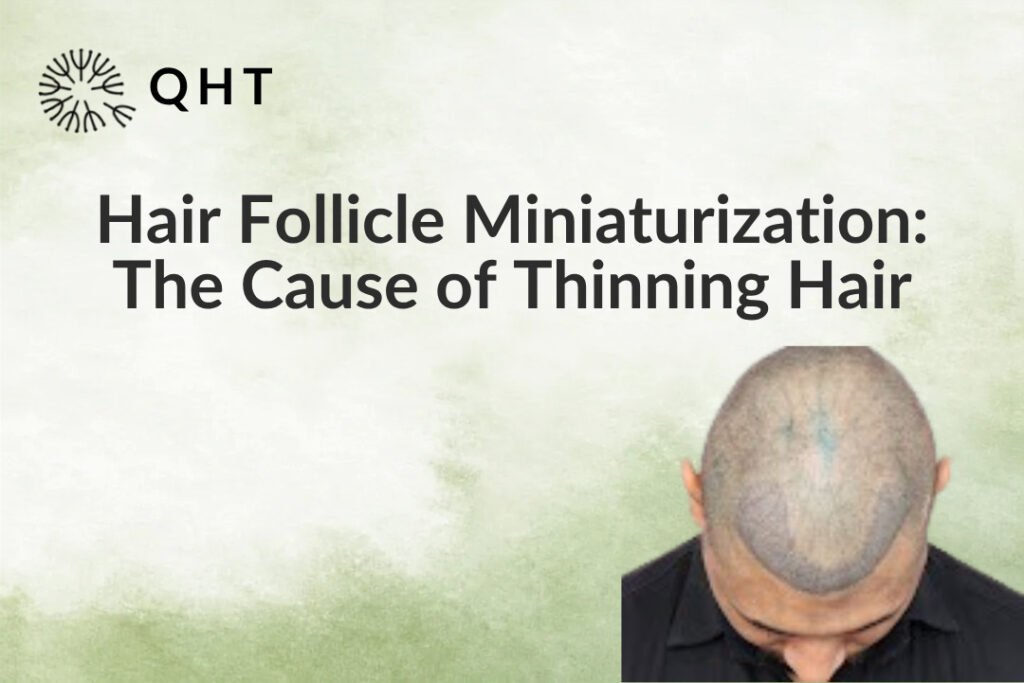
You style your hair one morning and notice the volume you remember six months ago is no longer evident. There simply isn’t the same density that used to be. Bizarrely though, it doesn’t look like you are losing your hair, per se.
The hair is still there – but smaller, weaker and almost invisible.
There’s a microscopic process you likely know nothing about occurring underneath your scalp – called miniaturization of hair follicles and it’s one of the most popular and seldom-discussed causes of hair loss.
What Exactly Is Hair Follicle Miniaturization?
Each individual strand of hair emerges from a tiny hair bulb nestled within the scalp – the hair follicle. Each well functioning follicle results in dark, strong, full and abundant hair that follows a complete hair growth cycle. Over time, as the miniaturization process starts the hair follicle becomes smaller and each new hair produced from this miniaturized hair follicle is thinner, shorter and less dark – until it’s so thin it’s almost undetectable to the eye. It isn’t a sudden hair loss, it’s a progressive loss – that’s the reason why many only realise they are experiencing hair thinning, after considerable hair thinning has already occurred.
Why Does Hair Follicle Miniaturization Happen?
There is absolutely no question that no. 1 factor is the hormone DHT(dihydrotestosterone). This DHT hormone is manufactured from your own body processing shed testosterone and, in the event that you’re inclined, works its harm, subtly killing off the hair follicle gradually over a prolonged duration by binding with the follicle receptors. The majority of us know this process as the source of both male and female pattern baldness.
Of course, you knew DHT isn’t the only villain – other issues such as stress and poor blood circulation to the scalp, nutritional insufficiencies (primarily lack of iron and zinc) , thyroid conditions, or extended crash dieting cycles may lead to accelerated hair follicle miniaturization.
Although these follicles aren’t dying immediately, they are slowly submitting to the inevitable – giving up and going into total arrest.
How Do You Know It’s Happening to You?
Here’s where it gets complicated. Since the hair doesn’t come out in chunks, many people believe nothing is wrong. At first, the signs of hair thinning are quite discreet- a larger part line or an area of the scalp visible under certain light or thinning hair which appears dull even right after shampooing and conditioning.
If you look really closely at any areas where thinning is apparent and can find both thick hairs mixed in with fine and near-transparent ones, you can almost be sure that miniaturisation has occurred. If you do find finer baby hair(vellus hairs) you know that the follicle is alive although it is currently producing a diminished strand. A thorough examination of the scalp by a hair growth specialist is the only method by which the true extent of miniaturization and the salvageability of remaining follicles can be assessed.
Can It Be Stopped or Reversed?
Yes – if caught in time, yes to a significant degree. For example, treatments such as minoxidil act by stimulating blood flow to the scalp, thereby enabling damaged hair follicles to grow healthy hair once again. Finasteride, the male patterned baldness drug, acts by directly reducing DHT at the root cause of its damage. PRP is a further potential treatment, which involves injecting a concentrate of blood platelets from your own body, into the areas of the scalp in which there is a loss of hair; these platelets then release growth factors that promote hair growth.
The emphasis is on early – once hair follicles are in their final stages of mini-miniaturization, no more treatment that stimulates growth at the scalp can bring it back to life.
When Does a Hair Transplant Become the Answer?
Once a person has undergone further hair loss where the doctor cannot do any more medical treatment, a hair transplant procedure is the best way out. Most people who go for a hair transplant in Gurgaon realise in the first consultation that their hair in affected areas can’t be revived with existing follicles and the only way to gain real hair density is to undergo the hair transplant. In this procedure, the hair follicles are transplanted from the back and the sides of the scalp which are naturally resistant to DHT and don’t cause loss in this way, into areas that have less density. When the transplanted follicles are moved to the loss area, they still carry their DHT resistance and continue to grow well.
The Bottom Line
Actually what thinning is – It’s about Hair Follicle Miniaturisation, Not Hair Fall. Thinning hair appears slowly and in the beginning without making much notice of. Many times, people only notice that a good portion of hair has already thinned.
Early detection makes a lot of differences. If you are detecting thinning and have the desire to know your current hair fall scenario, you may visit QHT Gurgaon for an in-depth consultation of your scalp and the options that exist, from non-surgical treatments to a permanent hair transplant in Gurgaon. Time can not wait.