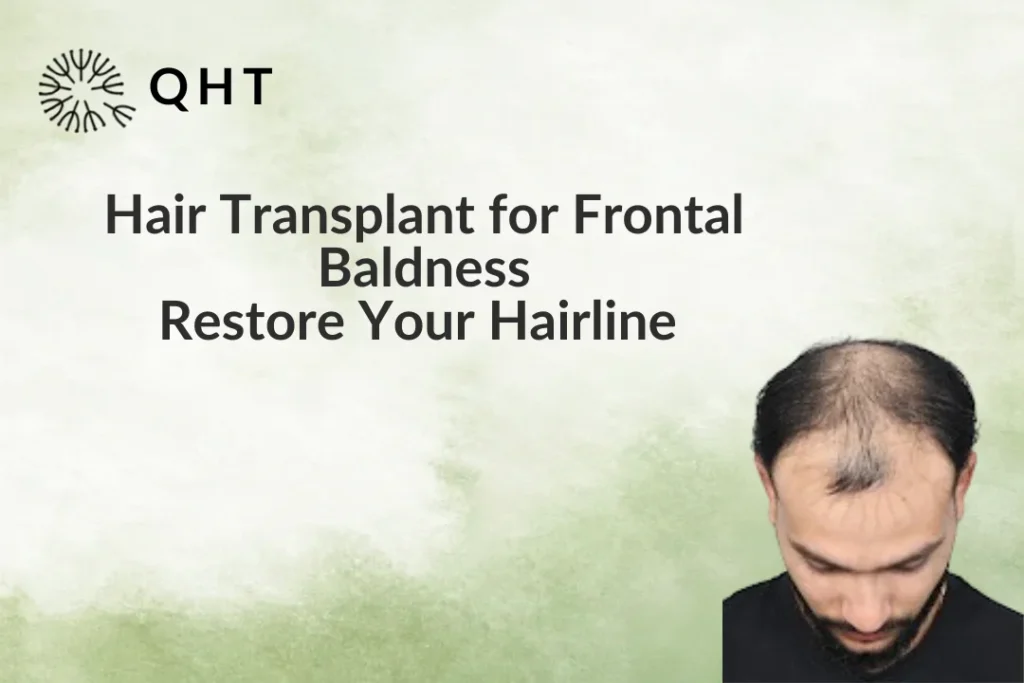
You woke up one morning, looked in the mirror, and again, your hairline has retreated further back. What was a slightly enlarged forehead has become an expanse of barren skin at the top front of your skull. Sound familiar? Frontal hair loss is a common and very demoralizing kind of hair loss because, more often than not, your hairline is the first feature of your face that people look at.
The best part? This hair loss condition is very treatable.
What Causes Frontal Baldness?
The most common and earliest region on the scalp affected by androgenetic alopecia, medically called female and male pattern hair loss, the frontal part is more often victim to such loss. The hair follicle is highly sensitive to DHT (dihydrotestosterone) hormones, which cause it to constrict, and result in finer and shorter hairs over time, till they no longer regrow. Most people have the gene; if your dad and dad’s dad had a hairline loss, it is probable that you do too. Although factors like stress, poor diets, and medication might accelerate the loss of hair on the front, a huge part of it lies in your DNA.
Why Is the Front of the Scalp So Tricky to Treat?
Creams, oils and shampoos never work effectively in the frontal area – and not for good reason. If a follicle in this region ceases or begins to shut down, topical applications will never reactivate it. Topical medications (such as minoxidil, finasteride) can certainly decelerate the loss process – however cannot fully reverse baldness. The surgical treatment becomes the most accurate alternative at this stage.
How Does a Hair Transplant Work for Frontal Baldness?
So how does frontal hair loss transplantation or FUE transplant work? It’s a pretty straightforward and advanced technique that involves harvesting DHT resistant healthy hair follicles from other parts of the scalp (donor areas), mostly the back or sides of the head and then meticulously implanting them into the frontal or affected areas that are suffering from baldness. Because the hair follicles are transplanted directly from your own scalp and they are DHT resistant in nature, they tend to grow in the frontal area just like they did originally and thus never fall off.
The main two ways to get the transplants are; FUE (Follicular unit extraction): This technique involves a specialist individually plucking the healthy follicles from the back of the scalp with the use of a punching tool and implanting them onto the frontal scalp, the advantages of FUE hair transplantation is that it leaves no linear scars and heals faster.
DHI (Direct Hair Implantation):This is a more sophisticated way of transplanting hairs that are similar to FUE but involves planting of follicles directly with the use of a specialized tool known as Choi implanter pen. This gives better results in the direction of planting and angle. In both cases the outcome is totally natural because it is your own hair that you have transplanted on your head.
What Makes a Natural Hairline?
This is where artistry and the ‘natural’ touch come into play beyond the basic technical process. No natural hairline is perfectly straight and even across the top and sides of the head. You should curve smoothly in a way that accentuates your face, reflects your age and corresponds to your underlying skull anatomy.
Skilled surgeons also pay attention to implanting the new hair at the appropriate angle so that the hair falls in a way that your natural hair does.
A badly drawn hairline can make even the most technically flawless surgery look obviously fake whether it is too low, too straight, or just too thick at the very front.
What to Expect After the Procedure?
The first few weeks post-transplant: you’ll experience minor scabbing and loss of some of the recently implanted hair – this is totally normal and is called shock loss. Hair will start growing significantly between months 3 and 4, with the most noticeable results seen at around months 9-12. The vast majority of patients are amazed at how natural the hair looks and how full the final result is. Most patients have very minimal downtime and can get back to work in about a week. Most patients can resume most normal activities in two weeks.
Why QHT Gurgaon?
If it sounds convincing to you, there’s nothing more than picking up the right clinic for the procedure. With the best hair transplant in Gurgaon, all surgeries are carried out by specialists who are exclusively trained in the field of hair restoration, unlike the general surgeons who have hair transplantation as a part time profession. Each patient’s frontal hairline is specially designed, and the consultation to follow-up sessions are conducted with full clarity and unhurried approach. To get your front hairline back where it used to be – naturally & for good – visit the QHT, Gurgaon for a free consultation.