Worried about swelling after hair transplant? One of the side effects we all get to see most in hair transplant is the swelling, especially on the forehead and under the eyes for up to two to five days after the procedure. The good news is that it often takes care of itself but to reduce some of it and to feel more comfortable during your recovery process, follow the proper after-care hair transplant regime. Read on to find out how to get up to speed on the subject.
Why Does Swelling Happen After a Hair Transplant?
Your body reacts to any insertion in your scalp by shunting extra fluid towards that location. Just the same way, your body reacts to an ankle sprain, or a small nick. Thet tumescent solution infused into the scalp will pool into the scalp area and migrate into surrounding areas, namely downwards by gravity; thus the presence of the puffiness around eyes and forehead two to three days after scalp surgery. None need to be anxious, and it resolves in 5 to 7 days without any therapy.
How to Reduce Swelling After a Hair Transplant: What Actually Works
Swelling is common after a hair transplant and usually improves within a few days. Following a few simple precautions during the first week can help reduce discomfort and support a smoother recovery.
1. Keep Your Head Elevated
Keeping your head elevated is one of the most helpful ways to manage swelling during the first few days. Elevation can help prevent fluid from collecting around the forehead and eyes.
- Sleep with your head elevated: Use two or three pillows or a suitable wedge pillow to keep your head raised.
- Avoid lying completely flat: Especially during the first few nights, as this may contribute to increased swelling.
- Keep your head slightly elevated during the day: When resting or relaxing, try to maintain an elevated position.
2. Use Cool Compresses in the Right Area
A cool compress may help reduce inflammation and discomfort, but it should be used carefully.
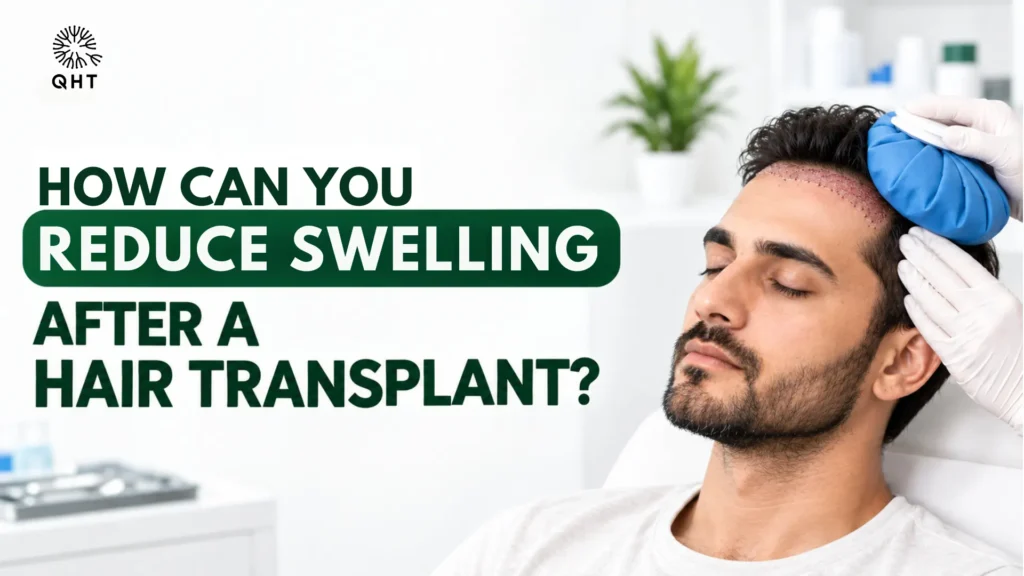
- Apply the cool compress only to the forehead. Avoid placing it directly on the transplanted grafts.
- Wrap the cold pack in a clean cloth: Never apply ice directly to the skin.
- Use it for around 10–15 minutes at a time: This can be repeated a few times a day during the first 48 hours, if advised by your clinic.
- Do not apply ice directly to the recipient area: The newly transplanted grafts should be protected from direct cold and pressure.
3. Avoid Bending Over and Heavy Lifting
Activities that increase pressure or blood flow to the head may make swelling worse. Take it easy during the early recovery period.
- Bend from your knees: If you need to pick something up, avoid bending your head below your waist.
- Avoid strenuous exercise: Your clinic may recommend avoiding the gym and heavy lifting for around 7–10 days or as instructed.
- Avoid inverted yoga positions: Do not perform headstands or poses that keep your head below your heart during the initial recovery period.
4. Stay Hydrated and Follow a Balanced Diet
Good hydration and a balanced diet can support your body’s natural healing process.
- Drink plenty of water: Aim for regular hydration throughout the day unless your doctor has advised otherwise.
- Limit salty and processed foods: Excess sodium can contribute to fluid retention.
- Avoid alcohol during the recommended recovery period: Alcohol may interfere with recovery and medications.
- Choose nutritious foods: Include fruits, vegetables, lean proteins, and other nutrient-rich foods.
5. Follow Your Prescribed Medications Carefully
Your hair transplant clinic may prescribe medications to manage swelling, discomfort, or prevent infection. Follow the instructions provided by your doctor.
- Take prescribed medicines exactly as directed.
- Complete antibiotics if they have been prescribed: Do not stop them early unless your doctor tells you to.
- Do not self-medicate: Avoid adding over-the-counter medicines or supplements without discussing them with your doctor.
- Follow your clinic’s aftercare instructions: Your surgeon’s advice should take priority because recovery recommendations can vary between patients.
What to Avoid During Recovery?
Avoid Making These Mistakes It is normal to see swelling after transplant surgery, and your healing will be slightly faster and swelling may not be as bad if you avoid the following:
i) Rubbing the swelling the transplants are going to be lifted off and this will agitate the tissue
ii) Placing ice directly over the transplanted area this will cause a great deal of damage to your grafts
iii) Having a drink it will thin out your blood, cause your body’s blood vessels to dilate and also cause increased swelling
iv) Staying up late at night your healing process occurs most extensively in the body when your are asleep
v) Jumping off the chair and freaking out if the swelling reaches your eyes there may be puffiness around the eyes between day three and four this is totally normal and will go away in two to three days
When Should You Call Your Clinic?
All swelling is either anticipated or harmless-however, you should contact your surgeon if you have:
i) Significantly more swelling than Day 5 onwards.
ii) Any redness, warmth, or discharge from the scalp
iii) Fever, significant pain in combination with the swelling
iv) No decrease in swelling, at all, by Day 10
These symptoms are indicative of a problem, such as an infection, and the sooner you communicate these problems to your clinic, the better.
Why Choosing the Right Clinic Matters for Recovery?
Your post-surgery swelling also depends greatly on the way the hair transplant procedure was carried out – be it the technique, the skill of the transplant surgeons and the gentle nature of the grafting. At QHT Clinic – identified as the one of the top hair transplant clinics in Gurgaon, we ensure that every transplant surgery is conducted at one of the best-in-the-class operation theatres by highly trained hair transplant professionals. Utilizing state-of-the-art FUE techniques with magnification equipment helps limit soft-tissue damage throughout the surgery and in turn keeps the swelling at the site of the hair transplantation low and promotes faster healing. We also educate every patient about the precise after-care measures to be taken.
Conclusion
Temporary, it is only a temporary stage in healing of hair transplant not side effects. With good day-to-day habits through the first week i.e elevated position in bed at night, use of a cold pad above the forehead, hydration, and good digestion with light meals, swelling recedes soon without leaving behind any undesirable sign.
In case you are seeking surgical precision as well as appropriate post operative support, take advantage of free consultation at QHT Clinic – best hair transplant in Gurgaon– and gain knowledge of best prescribed care suitable according to your recovery pattern.